Wednesday, June 28, 2006

INDIAN BRANDS HEAD FOR BEER RUN IN UK

Several Indian brands have made inroads into the British market, so much so that beer industry reports say "beers from the Indian subcontinent are now firm favourites with British drinkers.”

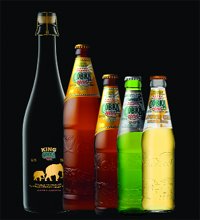
The success of pioneer brands such as Kingfisher is persuading other brewers to try their luck. Kingfisher was the first on the scene and, since then Cobra, Lal Toofan, Shere Khan, AdiAdi and Bangla have emerged. Others are in the pipeline and although the focus has inevitably been on Indian restaurants, brand owners are now exploring off-trade opportunities.

In a deliciously ironic twist, one of the brewers that intend to exploit India's growing love affair with beer is Cobra. Cobra, it is not an Indian beer but a British brand brewed in Bedford. It has been the undisputed success story of Indian-style lager in the past few years. Led by entrepreneur Karan Bilimoria, Cobra is made under licence by Charles Wells and, along with some smart marketing, has achieved success with a formulation that is deliberately less gassy than its competitors and so, it argues, a better match for Indian food.

AdiAdi is the new kid on the block, fresh out of Bangalore. It is being imported by Essential Garden, a company specialising in bringing food items into the UK from India. Founded by Pradeep Kumar and John Eipe and based in London's Canary Wharf, the business is concentrating its launch activity in the Indian restaurants but says the off-trade is in its sights.

Like Shere Khan, the lager launched in the Manchester that accom-panies Indian foods of the same brand name, AdiAdi claims to be a "smooth" but "zesty" beer that is made with Eastern cuisine in mind. The Far East Brewing Company, part of the Refresh UK group, has two Indian-style lagers in its portfolio: Lal Toofan and Bangla.

Meanwhile, the new Bombay Pilsner of London has also launched a "smooth" beer that is promoted as a good accompaniment to Indian food.

Wednesday, June 21, 2006

WHAT SHOULD BE THE IDEAL LEGAL DRINKING AGE??

If we can vote at 18, why can't we drink?

Delhi government has ignored the Centre's recommendation to lower the drinking age to 18. In its draft excise legislation, it has lowered the age to 21 from 25. Why an 18 year old can drive a car and vote but not drink is a question to which we are yet to find an answer....

While pub owners are happy with this more ‘‘realistic’’ approach of the government, a section of Delhiites has expressed concern that this would lead to more cases of drunken driving.

As for 18-year-olds, they feel if they’re allowed to drive, vote, marry and start a family at this age (if they are girls), handling drinks should hardly be an issue. The decision shows the double standards of our law-makers. If an 18 year old can be trusted with the future of the country, why not otherwise??

The government-run liquor shops don’t ask for an identity card, even when they know that the person buying alcohol is underage, let alone the pubs. So what’s the point? Most of the teenagers try a drink much before they turn 18 and if one is legally allowed to do so, things would be simpler.

In most countries the drinking age is 18. In many, it's even less. The US has fixed it higher at 21 and that's caused huge controversy. The Delhi government’s proposal to lower the drinking age from 25 to 21 has failed to lift the spirits of teenagers, who were desperately waiting for the age limit to be reduced to 18.

For more information on LEGAL DRINKING AGE

Thursday, June 08, 2006

DRAFT MODEL ALCOHOL POLICY: SALIENT FEATURES

The Ministry of Food Processing Industries has finalised its Draft Model Policy for the alcohol sector. The last time such an exercise was attempted was over a 100 years ago! To be sustainable and effective, the Policy recognises the role of drinking and the need to be practical and relevant to the lives of those they target. It is a well known fact worldwide — that policies cannot control consumption, hence they need to control harm. In view of this, policies now encourage consumption of drinks containing moderate forms of alcohol such as beer and wine. The Model Policy aims to achieve this by introducing tax structures which favour low alcohol products and by removing ambiguities from the existing system. The Policy also appreciates that the job and income multiplier of beer is greater than wine and spirits. Consequently, in most developed countries, taxes are relatively lower on beer as it has the highest share of about 60 percent in alcohol consumption.

In India however, the picture is entirely different and the new Policy seeks to address this. Share of beer is a mere four percent and while per capita consumption of spirits is at 65 percent of global average, per capita consumption of beer is just three percent of global average — a direct consequence of the archaic tax structure which instead of favouring beer actually discriminates against it. Globally average tax on beer is about half than on spirits, while in India tax on spirits is in line with global average but tax on beer is 60 percent higher than spirits and more than three times the global average. No wonder beer in India is unaffordable and the consumption of hard spirits is on the rise.

Salient Recommendations of the New Policy
  1. Tax on Beer 35% of MRP (ED 15% + ST 20%) Spirits/Country 60%; Wine 20%: States are further encouraged to reduce tax on beer by another five percent in phases if revenue gains are achieved. The proposal will help bring taxes on beer in line with global average, down from the current India average of 42 percent. It is also proposed that the fixed component of levies in terms of license fees should not exceed five percent of the MRP.
  2. Uniform MRP: Consumer prices to be uniform across all states and determined by manufacturers based on market forces and not dictated by government policy, as in other consumer goods.
  3. Interstate levies to be removed: Free movement of goods between states to encourage competition and enable manufacturers to get economies of scale. This is particularly pertinent in case of breweries where capital investments are high and large capacities are much more efficient.
  4. Retail outlets to be on fixed fee, longer term basis (no auction system): Remove monopolies and cartels that still prevail in some states, thereby encouraging competition, reducing consumer prices and leading to a better retail environment.
  5. Communication at point of sale / consumption for beer and wine: In order to enable consumers to make an informed choice and to promote responsible drinking.
  6. Modern breweries are to be permitted to have multi-purpose process areas/vessels, blending, flavouring, HG brewing, wort streaming etc. to improve efficiencies and enable innovative products. Moreover, with the recognition that brewing unlike distilling is a continuous process; the stages of monitoring and control have been greatly reduced. No wonder the current rules formulated in the early 20th century with largely distilling operations in mind, are obsolete and inappropriate in today's context.

Wednesday, June 07, 2006

NORTHERN STATES TO FUEL GROWTH FOR BEER INDUSTRY

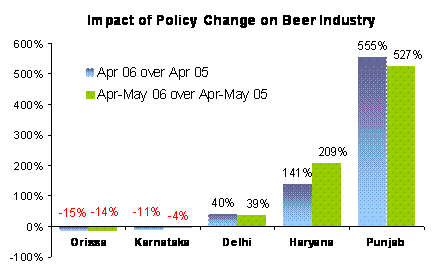
Taking a leaf out of the Model Excise Policy mooted by the Ministry of Food Processing Industries, the states of Punjab, Haryana and Chandigarh moved from the archaic auction to a retail fee system, removing the monopolistic nature of the business which was hurting consumer, manufacturers and government interests.

Some of the advantages this will have:
  • Consumer gets a better choice of brands at reasonable prices
  • Ensures that the distribution system (especially retail) does not capture a disproportionate amount of the value chain by leveraging their monopoly
  • The retail environment improves due to increased competition
  • Illicit liquor and smuggling from the neighbouring states will stop as the prices fall in line with the neighbouring states.

These markets have already begun to see the impact of this policy change with beer prices coming down to more realistic levels.

The previous year had seen the Rajasthan government effect a similar change. As a result, beer prices in Rajasthan nosedived from almost Rs. 60 to Rs. 45 per bottle and the Government increased its revenues from Rs. 1276 crore in 2004-05 to Rs. 1350 crore in 2005-06.

On the other hand in Maharashtra, Karnataka and Orissa, the latest dose of State Excise has sent prices of the golden brew skyrocketing. In Maharashtra, a bottle of mild beer that previously cost Rs. 52 with taxes, now costs Rs. 65 – showing a whopping 25 percent jump.

Predictable the beer market has been impacted adversely with Karnataka and Orissa witnessing negative growth at – 4% and – 14% percent respective. (Apr-May06 over Apr-May05).

Tuesday, June 06, 2006

HAYWARDS BLACK ROCKS KOLKATA

With the scorching summer pushing the Celsius to the 40-plus mark, what better news than the launch of a new beer.

After the debut launch in Noida, Calcutta is the second place where Haywards Black stout beer was launched. Stout beer is a dark beer. Haywards Black is a blend of Caledon Valley roasted barley malt, pale malt and Alpha hops from New Zealand.

The beer, being brewed at Rochees Breweries Limited in Rajasthan, ensures that a slow brewing process with special yeast creates a creamy head and a rich, smooth taste.

In keeping with the Indian palate, Haywards Black is less bitter and more smooth than regular stout beer. The use of dark roasted malt renders the dark colouring along with a smoky taste.

Currently in Kolkata the beer is available at Taj Bengal, The Park, Hyatt Regency Calcutta, ITC Sonar Bangla Sheraton & Towers and select liquor shops in the city.

Pocket pinch: Haywards Black is available in 330 ml bottles and is priced at Rs 32.