Showing posts with label India Beer Industry. Show all posts

Thursday, July 06, 2006

BEER SALES NOSEDIVES IN KARNATAKA

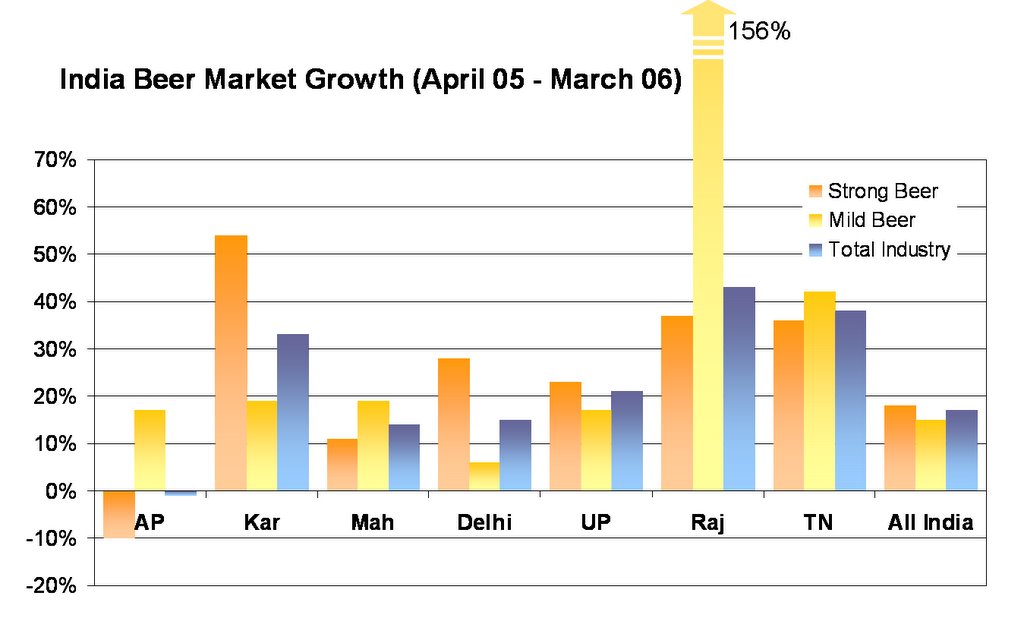
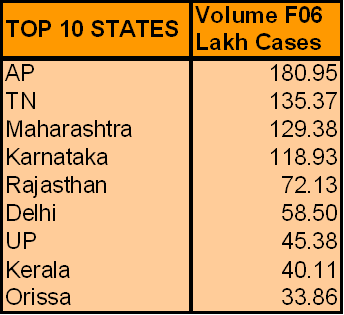
Beer volume in Karnataka is approximately 119 lakh cases (F-06). Growth of the mild segment is stable and overall growth being driven by the strong segment growing at a CAGR of 17.5%, whereas the total industry grew by 10% (F-99 to F-06).

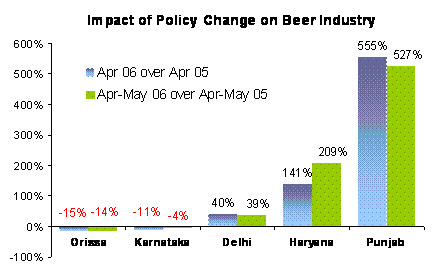
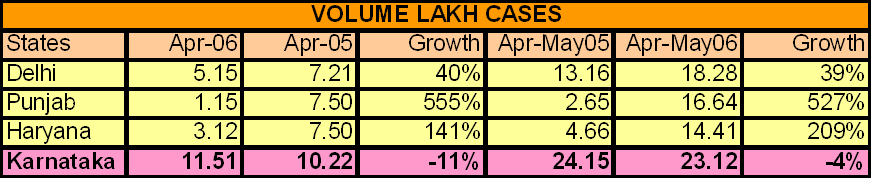
Traditionally Karnataka has been a very high potential market for beer. However, with the new excise policy which was announced a few months back, Karnataka has witnessed a huge drop in sales for the period April – May 2006 over the same period last year.
  • Excise duty on beer up from Rs. 4 per bulk litre to Rs.5 per bulk litre
  • Additional excise duty on beer up from Rs.22 per bulk litre to Rs.29 per bulk litre
  • Policy is not at all in line with international trends where preference is given to beer. Hence this is a regressive policy in technical sense.

The drop in volume can be related to the Price Elasticity of Beer in the state of Karnataka which is (-1.18).

Interestingly due to the progressive approach taken by governments of Punjab, Haryana and Rajasthan, sales have increased – thus increasing the revenues to the exchequer. The same is not the case with Karnataka.

The table below will clearly give you an indication of what we are talking and the kind of slide that the state of Karnataka has seen as compared to the mammoth growth witnessed in the states of Delhi, Punjab and Haryana.
Wednesday, June 28, 2006

INDIAN BRANDS HEAD FOR BEER RUN IN UK

Several Indian brands have made inroads into the British market, so much so that beer industry reports say "beers from the Indian subcontinent are now firm favourites with British drinkers.”

The success of pioneer brands such as Kingfisher is persuading other brewers to try their luck. Kingfisher was the first on the scene and, since then Cobra, Lal Toofan, Shere Khan, AdiAdi and Bangla have emerged. Others are in the pipeline and although the focus has inevitably been on Indian restaurants, brand owners are now exploring off-trade opportunities.

In a deliciously ironic twist, one of the brewers that intend to exploit India's growing love affair with beer is Cobra. Cobra, it is not an Indian beer but a British brand brewed in Bedford. It has been the undisputed success story of Indian-style lager in the past few years. Led by entrepreneur Karan Bilimoria, Cobra is made under licence by Charles Wells and, along with some smart marketing, has achieved success with a formulation that is deliberately less gassy than its competitors and so, it argues, a better match for Indian food.

AdiAdi is the new kid on the block, fresh out of Bangalore. It is being imported by Essential Garden, a company specialising in bringing food items into the UK from India. Founded by Pradeep Kumar and John Eipe and based in London's Canary Wharf, the business is concentrating its launch activity in the Indian restaurants but says the off-trade is in its sights.

Like Shere Khan, the lager launched in the Manchester that accom-panies Indian foods of the same brand name, AdiAdi claims to be a "smooth" but "zesty" beer that is made with Eastern cuisine in mind. The Far East Brewing Company, part of the Refresh UK group, has two Indian-style lagers in its portfolio: Lal Toofan and Bangla.

Meanwhile, the new Bombay Pilsner of London has also launched a "smooth" beer that is promoted as a good accompaniment to Indian food.

Wednesday, June 07, 2006

NORTHERN STATES TO FUEL GROWTH FOR BEER INDUSTRY

Taking a leaf out of the Model Excise Policy mooted by the Ministry of Food Processing Industries, the states of Punjab, Haryana and Chandigarh moved from the archaic auction to a retail fee system, removing the monopolistic nature of the business which was hurting consumer, manufacturers and government interests.

Some of the advantages this will have:
  • Consumer gets a better choice of brands at reasonable prices
  • Ensures that the distribution system (especially retail) does not capture a disproportionate amount of the value chain by leveraging their monopoly
  • The retail environment improves due to increased competition
  • Illicit liquor and smuggling from the neighbouring states will stop as the prices fall in line with the neighbouring states.

These markets have already begun to see the impact of this policy change with beer prices coming down to more realistic levels.

The previous year had seen the Rajasthan government effect a similar change. As a result, beer prices in Rajasthan nosedived from almost Rs. 60 to Rs. 45 per bottle and the Government increased its revenues from Rs. 1276 crore in 2004-05 to Rs. 1350 crore in 2005-06.

On the other hand in Maharashtra, Karnataka and Orissa, the latest dose of State Excise has sent prices of the golden brew skyrocketing. In Maharashtra, a bottle of mild beer that previously cost Rs. 52 with taxes, now costs Rs. 65 – showing a whopping 25 percent jump.

Predictable the beer market has been impacted adversely with Karnataka and Orissa witnessing negative growth at – 4% and – 14% percent respective. (Apr-May06 over Apr-May05).

Tuesday, May 30, 2006

INDIAN ALCOHOLIC BEVERAGE INDUSTRY STATISTICS: IWSR REPORT

Below is an over-simplified analysis of the very real differences between India and all other markets; this is drawn from the opinions of Indian management who understand the markets in great depth.

  • India is 28 countries in the context of one. (There are 31 states but some are very small). There are at least 23 quite different markets of importance. In practice, these are largely self-contained markets, with limited cross-border sales, except by smuggling.
  • Each state levies taxation on alcohol at its own determined rates and excise duties, and controls distribution channels in its own way. It is a state-by-state not a national market. Taxes are levied, often at relatively high rates in relation to Indian prices, on all alcoholic products crossing the state borders. The result is that it is essential to have centres of production spread over the major states.
  • The intention to reduce alcohol consumption is written into the Constitution.
  • The population is evidently huge (945 million in 1996 and over 1.1 Billion during 2004). It is still growing by 20 million plus every year, though this may have eased in 2003. However, 600 million at least are still outside the market for anything except very cheap Country Liquor. Advertising has always been officially illegal. In practice, all major brands spent heavily on Surrogate brands under the same brand name (on glasses, mineral waters, bottle openers, fashion articles for men etc.).
  • The Distribution system is still the same for Beer as for Spirits and Wine. All outlets must be licensed; Wholesalers, Retailers, Bars and Restaurants, and Bonded Warehouse operators. They pay the, varying, States licence fees. These can, at present, only sell Indian-made Liquor over most States. It continues to be expected that Beer and Wine may shortly be permitted to sell in more outlets.
  • South India is the largest consumer of IMFL and Beer. It is more important than North and West together. Tax-paid Country Liquor is most important in North and West.
  • The West is declining due to high taxes, and the North increasing in Country Liquor and Beer particularly.

Download the full report: India Alcoholic Beverages Industry Statistics.pdf

Thursday, May 25, 2006

AIBA RECOMMENDS BEER RETAILING ON FIXED FEE BASIS

In order to give a fillip to the Indian beer industry, the All India Brewers Association (AIBA) has called the state governments to draft their excise policies on the basis of the Model Excise Policy suggested by the food processing ministry. AIBA has also called for adopting the retailing of beer on a fixed fee basis as opposed to the auction system.

In 2004-05, the beer market was pegged at 9.4 crore cases and registered a growth of 14% to touch 10.9 crore cases, because of the excise policy of Rajasthan and Karnataka.

These two states also moved from the auction system of retailing to a fixed fee system, thus impacting the volume sales of beer. If other states also follow this, it would promote the beer industry, which is by far safer than hard liquor. AIBA is also recommending removal of inter-state levies and restriction of licence fees to exceed 5% of MRP.

The food processing ministry in its model excise taxation paper has called for the preferential treatment to beer. It has argued that the growth of beer industry, will lead to multi-fold benefits to the farmers.

"If the demand for beer in India were to grow to the same level as spirits, the demand for malted barley along with other crops used for beer production would increase 20-fold, and over 10 lakh farmers would benefit. Similarly, the economic value generated at the farm level from barley used by the beer industry would go up from approx Rs 60 crore to Rs 1,200 crore," the paper said.

Cultivation of hops (flavouring and stability agent in beer) presents another major opportunity for farmers, as it is grown in hilly regions where crop opportunities are few, the paper adds. As per industry estimates, 45-50 tonne of hops worth Rs 70 lakh is currently being grown in India impacting 650-700 farmers.

Wednesday, May 24, 2006

RAJASTHAN CASE STUDY

Year 2005 saw Rajasthan government changing from auction system to a new system of corporation. The aim was to remove the monopolistic nature of the business wherein the contractors were becoming more powerful and in the process consumer, manufacturers and government interest were not being protected.

This new system will make sure that this monopolistic cartel is broken and the situation is a win – win for the other stakeholders. The consumer will get the product at a realistic rate and the government will benefit in terms of revenue. According to a rough estimate the government is set of get revenue of Rs 1350 crore this year Vis a Vis a revenue of Rs 1276 crore last year. Therefore just by doing some structural changes the government will be able to earn Rs 74 crore, not to mention the benefits to the manufacturing companies and the consumer.

No wonder that more brewers have announced their plans to enter the state given the wise move taken by the government to minimize the impact of the middlemen on the entire value chain.

Listed below are some of the benefits this policy has given to the state.

  • Fixed MRP – Consumer is protected as no arbitrary pricing as is the case with the auction system.
  • Brand availability – Now brands are available as per consumer demand and not driven by contractors desire to push high margin lesser known brands.
  • Manufacturers get a better deal with the State Corporation in charge of wholesale distribution
  • No credit exposure
  • Not at the mercy of the contractors arbitrariness
  • Better price realization
  • It is an investment friendly change in policy, forward looking and pragmatic

Going forward, the government should keep up the process of reforming system while creating policies which are beneficial to the state economy and to its people.

Thursday, May 11, 2006

NO CHILLED SUMMER FOR BEER INDUSTRY

May be Chilled Beer??

Interesting article which appeared in Mumbai Mirror recently.

Age-old excise policy on liquor and multiform regulations are hitting the beer industry

Brewers in the country are asking not to be regulated under the Punjab Excise Policy of 1905 for distilleries as it now affects them adversely. The government’s policy, which inadvertently discourages breweries, while encouraging distilleries, has put the beer industry at a disadvantage.

With regard of the Punjab Excise Policy, there are certain compliances mentioned in the policy, which are no longer feasible – and despite repeated pleas to the government there is no amendment to the age-old law.

According to the policy, liquor manufacturers cannot operate at nights and the operator is required to close operations after dark till the next day.
This policy is alright for the distilleries as there are chances of making spurious spirits and also of excise theft during the wee hours. However, there is no scope of making spurious beer as that process is as costly.

Also, there are different regulations in different states. An individual of 18-years and above can consume alcohol in Goa but not in Mumbai. Mumbai’s age criterion is 21-years whereas in Punjab, the age bar is 25 years.

Average global taxes on price of the beer are 33.6 per cent whereas, in India, taxes on beer are about 49 per cent and therefore, affordability of beer in the country is lowest compared to world standards. This way, the government is encouraging hard-liquor that is more harmful to the consumers.